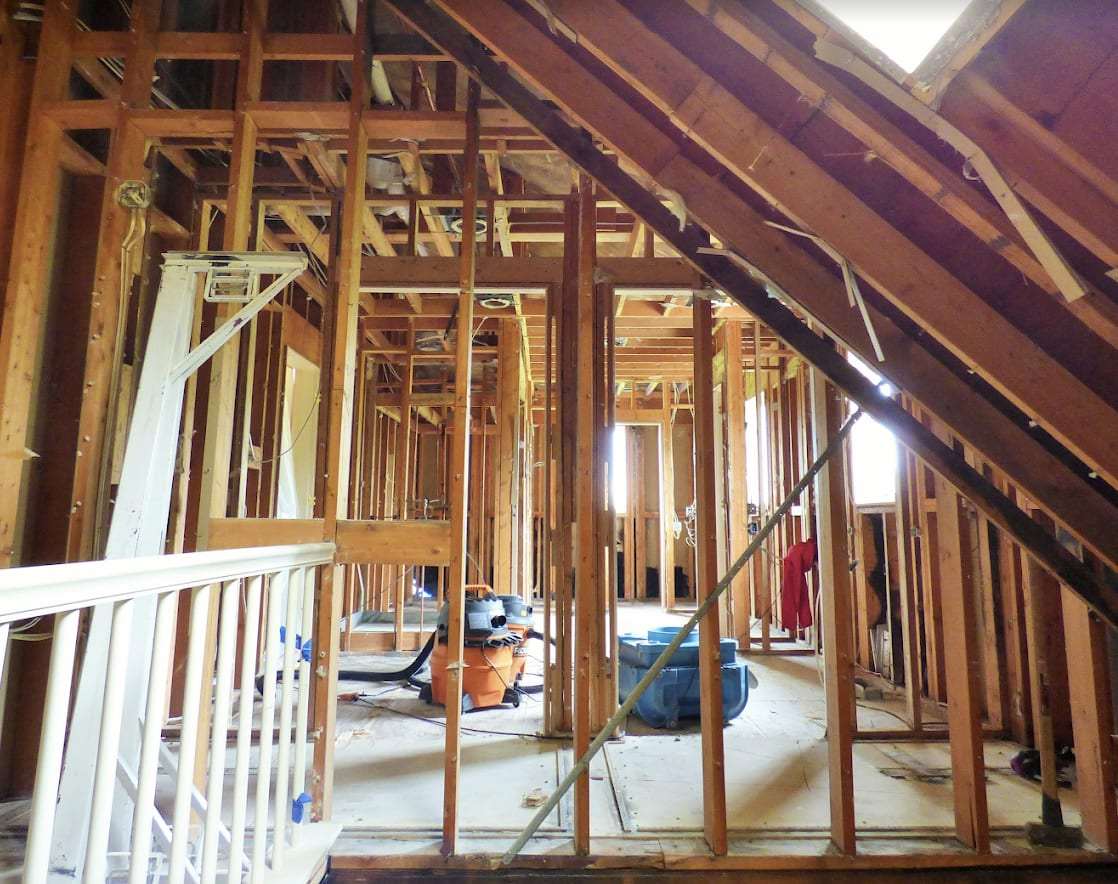
Attic and upper floor opened to the framing during reconstruction. Illustrative only: this photo is not from a job tied to this site or a specific address.
The stage most people never see
After a fire, the mitigation stage removes what cannot be saved and cleans what can. In the rebuild, the first real decision is about the bare studs, joists and rafters left behind. Wood that is only smoke-stained can usually stay after it is cleaned. Wood that is charred deeply enough to lose strength may need to be replaced or reinforced, and that judgment sometimes calls for an engineer or the building inspector.
Smoke odor lives in porous surfaces. If stained framing is closed in without being cleaned and sealed, odor can return when the weather warms or the furnace runs. Contractors commonly apply a shellac-based or other odor-blocking primer to cleaned framing before insulation. Ask what product will be used and where.
Electrical wiring, plumbing and ductwork in fire-affected walls also need attention before closing. Heat can damage wire insulation well away from visible flames, and ductwork can carry soot to rooms the fire never reached.
What usually happens between demolition and drywall
Structural assessment
Charred members are probed and assessed. Replacement or sistering is decided and, if needed, engineered.
Cleaning
Soot is removed from framing, sheathing and the underside of decking by methods suited to the residue.
Sealing
Cleaned surfaces in the affected area are coated with an odor-sealing primer.
Systems repair
Wiring, plumbing and ducts in the area are repaired or replaced and inspected as required.
Rough inspection
The building inspector reviews framing and systems before insulation goes in.
Odor check
Before insulation, someone should stand in the closed-up room and confirm there is no lingering smell.
Ask to see these before insulation goes in
- Photos of every opened wall and ceiling bay in the fire area
- Which framing members were replaced, sistered or left in place
- Where odor sealer was applied, including attic and ceiling joists
- Notes on wiring that was replaced versus inspected and kept
- Confirmation that ductwork in the area was cleaned or replaced
- Any engineer letter or inspector note on structural repairs
Common questions
- Does all framing in the house need sealing?
- Usually only framing in areas where smoke residue reached the wood. Ask the contractor to mark the sealing boundary on a sketch so you know what was treated.
General information for Littleton, not a quote or professional advice. In an emergency, call 911.